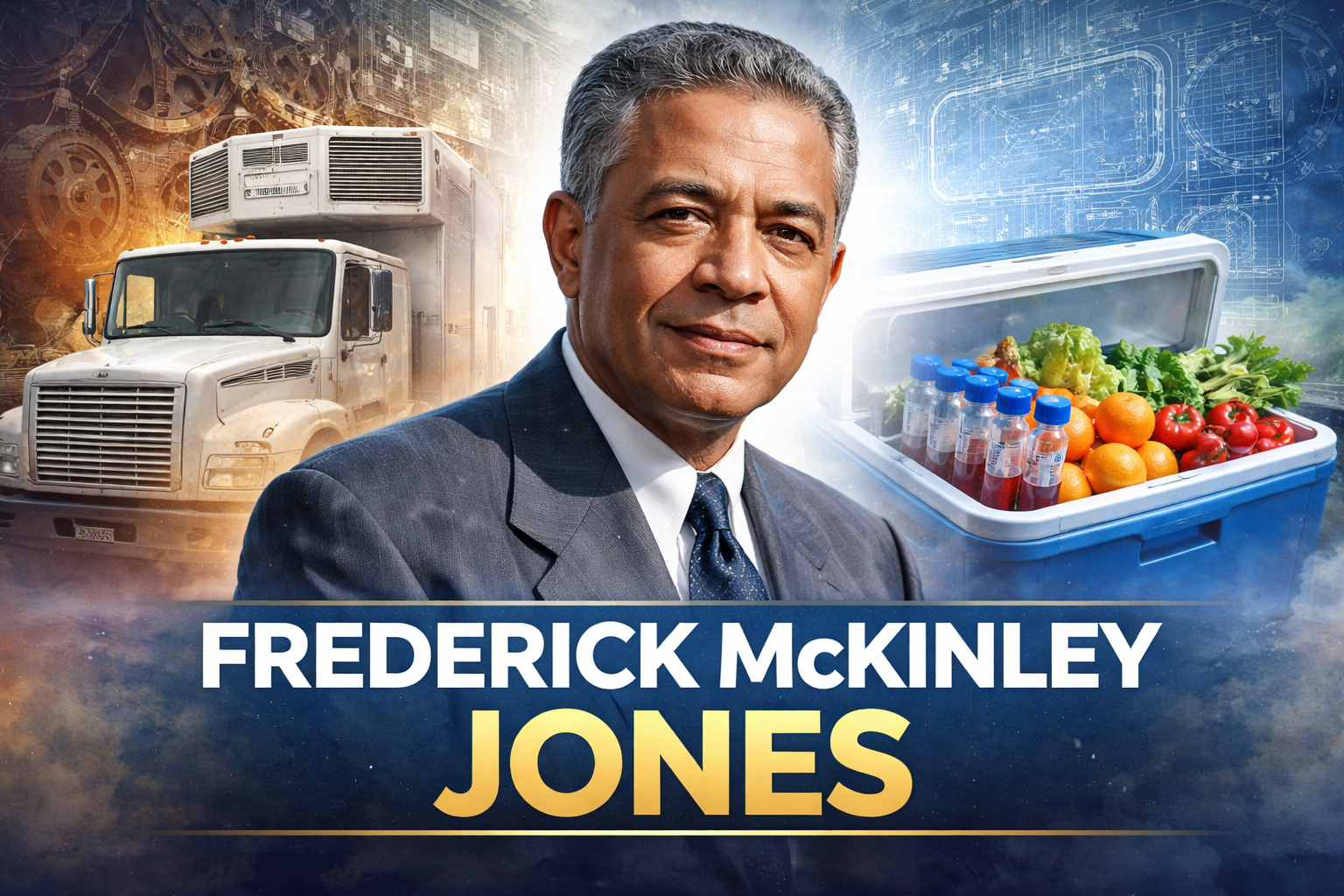
Frederick McKinley Jones: The Mind That Changed Modern Life
Frederick McKinley Jones is one of those rare figures whose work quietly reshaped the modern world. His inventions made it possible to transport fresh food, medicines, and blood safely across long distances. Yet for many people, his name is still unfamiliar.
This article is written to answer a simple but important question: who was Frederick McKinley Jones, and why does his work still matter today?
What follows is not a surface-level biography. It is a deep, people-first exploration of his life, ideas, challenges, and lasting impact. The goal is to explain his contributions clearly, honestly, and with real-world relevance, without exaggeration or filler.
Who Was Frederick McKinley Jones?
Frederick McKinley Jones was an American inventor, engineer, and entrepreneur best known for developing practical refrigeration systems for trucks, ships, and railcars. These systems made long-distance transport of perishable goods reliable for the first time.
He was born in 1893 in Cincinnati, Ohio. His early life was shaped by instability, limited formal education, and constant self-teaching. Despite these obstacles, he became one of the most prolific inventors of the twentieth century, holding more than 60 patents.
What makes his story remarkable is not just the number of inventions, but the scale of their impact. Modern cold-chain logistics, from grocery stores to vaccine distribution, traces back to his work.
Early Life and the Roots of a Self-Taught Engineer
Jones lost his mother at a young age and grew up in a series of foster homes. He left school early, reportedly after the sixth grade. For many people, that would have closed doors permanently. For him, it became the beginning of an unconventional education.
As a teenager, he showed an intense curiosity about how machines worked. He taught himself mechanical engineering, electronics, and radio repair by reading manuals, experimenting, and learning through trial and error.
By his early twenties, he was already repairing complex equipment and inventing mechanical solutions for real-world problems. This hands-on learning shaped his approach throughout life. He focused on practical outcomes rather than theory alone.
Early Inventions Before Refrigeration
Before refrigeration became his defining achievement, Jones had already built a reputation as an inventive problem-solver.
Some of his early work included:
- Mechanical improvements for farm equipment
- Radio transmitters and receivers
- Motion picture sound equipment for early talking films
- Devices for industrial automation
These projects revealed a consistent pattern. He identified inefficiencies in existing systems and redesigned them to be simpler, more reliable, and easier to maintain.
This mindset later proved critical when tackling the problem of mobile refrigeration.
The Problem That Changed Everything
In the early twentieth century, transporting fresh food over long distances was risky and inefficient. Ice-based cooling systems were unreliable, bulky, and difficult to control. Temperature fluctuations often led to spoilage.
The lack of dependable refrigeration limited food distribution and made it nearly impossible to move fresh produce, meat, or dairy across regions.
Jones recognized this as both a technical challenge and a humanitarian one. Solving it would reduce waste, improve nutrition, and stabilize food supply chains.
Reinventing Mobile Refrigeration
Jones developed a compact, engine-powered refrigeration unit that could be mounted on trucks and other vehicles. Unlike ice-based systems, his design maintained consistent temperatures regardless of external conditions.
Key breakthroughs in his system included:
- Automatic temperature control
- Integration with vehicle engines
- Compact and durable mechanical design
- Reliability across long journeys
This was not a single invention but a series of refinements. He tested, failed, adjusted, and tested again until the system worked in real-world conditions.
This practical approach is why his refrigeration technology was adopted quickly by industries that needed reliability above all else.
Founding Thermo King
To scale his inventions, Jones co-founded a company that later became known as Thermo King. The business focused on manufacturing and distributing refrigeration units for commercial use.
Thermo King played a central role in bringing his technology to market. It allowed his ideas to move beyond prototypes and into widespread industrial adoption.
This step matters. Many inventors create brilliant designs that never reach real users. Jones understood that impact required production, distribution, and support, not just patents.
World War II and Life-Saving Applications
One of the most important chapters in his career occurred during World War II.
Refrigeration units based on his designs were used to:
- Transport blood plasma safely to field hospitals
- Preserve medical supplies in extreme conditions
- Support food distribution for troops
This application extended his impact beyond commerce into lifesaving medical logistics. It also demonstrated the versatility and robustness of his designs under pressure.
Medical historians often point to refrigerated blood transport as a turning point in battlefield medicine. Jones’s work was a key enabling factor.
Recognition and Historic Achievements
Despite facing racial discrimination throughout his life, Jones earned recognition for his contributions.
Notable achievements include:
- Becoming the first Black inventor inducted into the National Inventors Hall of Fame
- Receiving the National Medal of Technology posthumously
- Holding more than 60 patents across diverse fields
These honors came slowly and, in some cases, after his death. That delay reflects broader social barriers rather than the value of his work.
Why His Work Still Shapes Daily Life
Many people interact with the results of Jones’s innovations every day without realizing it.
Examples include:
- Fresh produce in supermarkets year-round
- Temperature-controlled pharmaceutical transport
- Frozen foods distributed globally
- Organ transplant logistics
Modern cold-chain infrastructure builds on principles he helped establish. While technology has advanced, the core idea of reliable mobile refrigeration remains unchanged.
Technical Principles Behind His Refrigeration Systems
At a high level, his systems relied on well-understood refrigeration cycles. What made them revolutionary was how they were applied in mobile environments.
Challenges he solved included:
- Vibration and motion during transport
- Limited space on vehicles
- Variable engine power
- Exposure to weather extremes
His designs emphasized durability and serviceability. Components were built to be repaired in the field, not just in workshops.
This focus on real operating conditions set his work apart from more fragile laboratory designs.
Barriers, Bias, and Professional Resistance
It is important to address the social context in which Jones worked.
As a Black inventor in early twentieth-century America, he faced systemic barriers, including limited access to funding, skepticism from industry leaders, and exclusion from professional networks.
He often had to prove his ideas repeatedly before they were taken seriously. In some cases, others attempted to claim credit for his work.
Understanding these challenges adds depth to his achievements. His success was not just technical but also personal and social.
Lessons Modern Innovators Can Learn
Jones’s career offers practical lessons for engineers, founders, and problem-solvers today.
Focus on Real Problems
He worked on issues that mattered deeply to people and industries, not abstract ideas.
Test in Real Conditions
His systems were refined through use, not theory alone.
Learn Continuously
Despite limited formal education, he never stopped learning.
Think Beyond the Invention
He understood that manufacturing and distribution were part of innovation.
These principles remain relevant across fields, from hardware to software.
Misconceptions About His Work
Several myths often appear in simplified accounts of his life.
One misconception is that he invented refrigeration itself. In reality, refrigeration existed long before him. His contribution was making it mobile, reliable, and commercially viable.
Another misconception is that his success was immediate. In truth, it took years of iteration, persuasion, and setbacks.
Clearing up these misunderstandings helps preserve historical accuracy and respect for the complexity of innovation.
Broader Economic and Social Impact
The economic effects of mobile refrigeration are difficult to overstate.
They include:
- Expansion of national and global food markets
- Reduction in food waste
- Stabilization of food prices
- Improved access to fresh foods in urban and remote areas
These changes influenced public health, agriculture, and global trade patterns over decades.
Jones did not just invent a machine. He helped enable a system that supports billions of people.
Ethical Dimensions of His Legacy
There is an ethical dimension to his work that deserves attention.
By improving food and medical logistics, his inventions contributed to better health outcomes. However, they also supported large-scale industrial food systems with complex environmental impacts.
Recognizing both sides encourages a balanced understanding of technological progress. Innovation solves problems but also creates new responsibilities.
How His Story Is Taught Today
In recent years, educators and historians have worked to include his story more prominently in science and engineering education.
His life is often used to illustrate:
- The value of hands-on learning
- The importance of diversity in innovation
- The impact of infrastructure-level inventions
These narratives help students see innovation as accessible rather than reserved for a narrow group.
Frequently Asked Questions
What is Frederick McKinley Jones best known for?
He is best known for developing practical mobile refrigeration systems that enabled safe transport of perishable goods.
Did he have formal engineering training?
No. He left school early and taught himself engineering through experience and study.
How many patents did he hold?
He held more than 60 patents across mechanical, electrical, and refrigeration technologies.
Why was his refrigeration system different from earlier ones?
It was compact, engine-powered, and reliable in moving vehicles, unlike ice-based systems.
Did his work have medical applications?
Yes. His technology was used to transport blood plasma and medical supplies during World War II.
Conclusion
Frederick McKinley Jones represents a form of innovation rooted in necessity, persistence, and real-world problem-solving. His work reshaped food distribution, medical logistics, and industrial transport in ways that continue to influence daily life.
Understanding his legacy requires looking beyond a single invention and appreciating the systems he helped create. His story reminds us that transformative ideas often come from those willing to learn continuously and challenge existing limits.