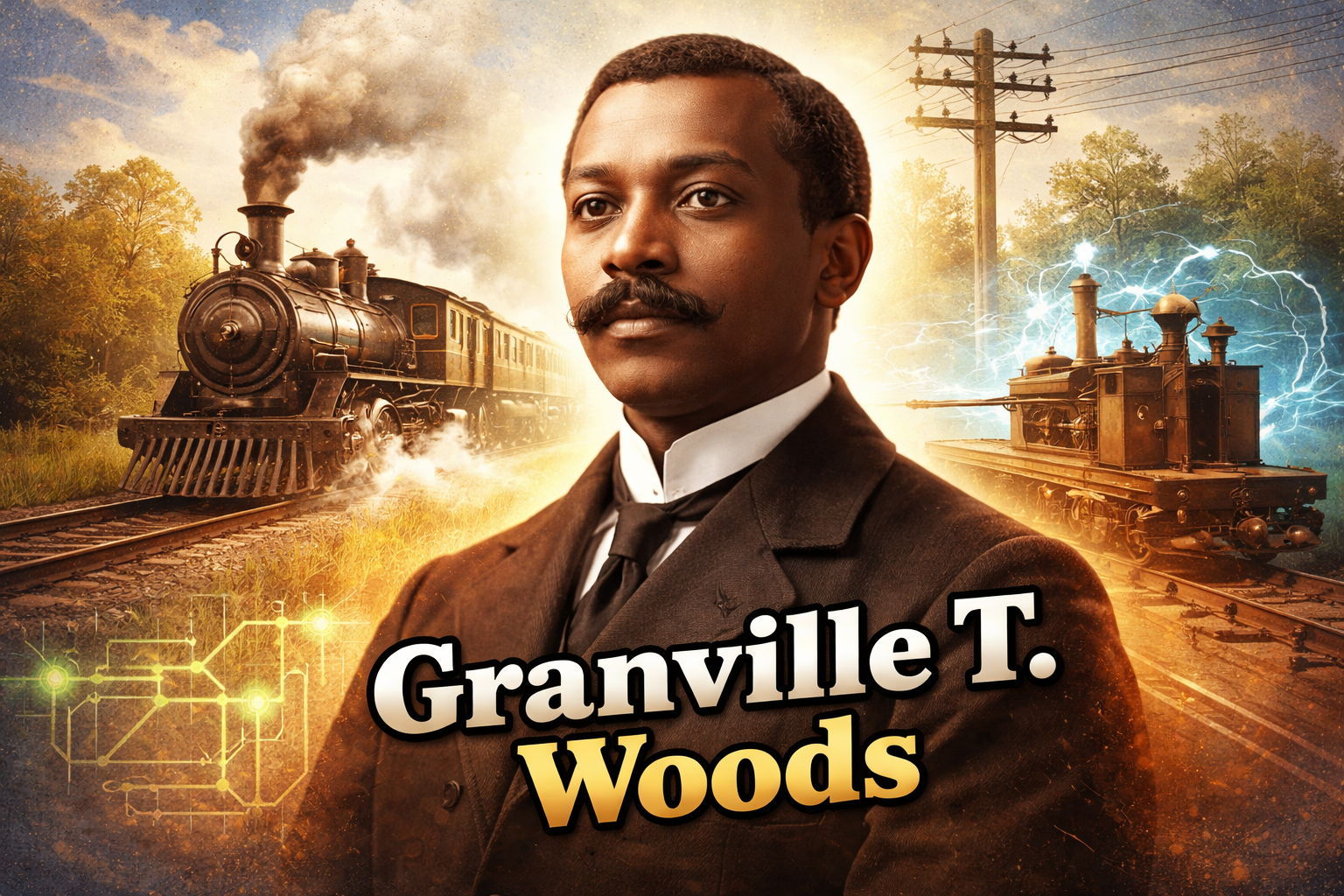
Granville T. Woods: The Engineer Who Changed Modern Transportation
Granville T. Woods is one of the most important yet historically underrepresented inventors in American industrial history. Often referred to as the “Black Edison,” his work shaped modern transportation, communication, and electrical engineering at a time when racial barriers were extreme and systemic. Understanding his life and contributions is not just about honoring the past. It is about recognizing how innovation often advances despite social resistance, limited resources, and lack of recognition.
This article explores his life, technical achievements, real world impact, and the challenges he faced as a self-taught engineer. It is written for readers who want more than surface-level facts. You will gain context, technical clarity, and a deeper appreciation of why his work still matters today.
Who Was Granville T. Woods?
Granville T. Woods was an American inventor and electrical engineer born in 1856 in Columbus, Ohio. He grew up during the post-slavery era, a period marked by limited educational and professional opportunities for Black Americans. Despite these constraints, he developed a deep interest in mechanics and electricity.
What makes his story remarkable is not just the number of patents he held, but the practical nature of his inventions. His work directly improved safety, efficiency, and communication in railway systems and electrical infrastructure. Many of his ideas were implemented during his lifetime, even if his name was not always credited.
Early Life and Education
Woods had very little formal schooling. He attended school until around age ten, then began working to support himself. His early jobs included positions as a machinist and a fireman on steam locomotives. These roles gave him hands-on exposure to mechanical systems and rail operations.
Instead of attending a traditional engineering school, he educated himself through:
- Apprenticeships in machine shops
- Independent study of electrical theory
- Practical experimentation with mechanical devices
This real-world learning approach shaped his engineering mindset. He focused on solving practical problems rather than pursuing purely theoretical ideas.
Historical Context and Barriers
To understand the importance of Woods’s work, it is essential to understand the era he lived in. The late nineteenth century was a time of rapid industrial growth in the United States. Railroads expanded across the country, cities electrified, and communication technologies evolved quickly.
However, this period was also marked by:
- Legal segregation
- Limited patent protection for Black inventors
- Discrimination in hiring and financing
- Frequent intellectual property theft
Woods often struggled to secure funding for his inventions. He also faced repeated legal battles defending his patents against larger corporations and well-known inventors.
Core Engineering Contributions
Woods held more than 60 patents in the United States, with many additional patents registered internationally. His work spanned multiple technical fields, but transportation and electrical communication were his strongest areas.
Railway Communication Systems
One of his most impactful inventions was an advanced system that allowed moving trains to communicate with stations and with each other. Before this innovation, trains relied heavily on visual signals and fixed telegraph stations, which increased the risk of collisions.
His system made it possible to:
- Transmit messages between trains without stopping
- Improve scheduling accuracy
- Reduce accidents caused by miscommunication
This technology laid the groundwork for modern train signaling and communication systems.
Induction Telegraph
The induction telegraph was a breakthrough in wireless communication along railway lines. It allowed messages to be sent between a moving train and a station without physical wires.
Key advantages included:
- Increased safety on busy rail lines
- Reduced infrastructure costs
- Greater reliability in poor weather conditions
This invention was especially valuable for long-distance rail networks where installing and maintaining wires was expensive and inefficient.
Electrical Power Innovations
Woods also developed improvements in electrical power distribution. His inventions addressed problems such as inconsistent voltage and inefficient current flow.
These innovations contributed to:
- More stable electrical systems
- Improved urban electrification
- Better integration of power and transportation networks
Although he did not operate a large manufacturing company, many of his designs were adopted by existing firms.
Real World Impact of His Work
The true measure of an engineer’s success is how widely their work is used. Woods’s inventions were not experimental curiosities. They were deployed in active railway systems and electrical networks.
Transportation Safety
Before his communication systems, railway accidents were common. Human error, delayed signals, and mechanical failures caused frequent collisions.
His technologies helped:
- Prevent rear-end train collisions
- Improve coordination on shared tracks
- Enable safer high-speed travel
These improvements saved lives and increased public trust in rail transportation.
Urban Growth and Electrification
As cities expanded, the demand for reliable power and transportation increased. Woods’s electrical inventions supported:
- Electric streetcars
- Urban rail systems
- Integrated power distribution
These systems enabled cities to grow more efficiently and sustainably.
Patent Disputes and Professional Conflicts
Woods’s success brought him into conflict with powerful figures in the engineering world. He was involved in multiple patent disputes, including conflicts with well-known inventors and corporations.
One notable pattern was that larger companies often attempted to challenge or invalidate his patents rather than license them fairly. Woods defended himself in court several times and won important cases, proving the originality of his work.
These legal battles highlight two important realities:
- His inventions were valuable enough to challenge
- He had to fight harder than most to protect his ideas
Despite winning cases, the financial and emotional cost was significant.
Relationship With Major Industrial Firms
Woods was sometimes offered opportunities to sell his patents or work exclusively for large companies. In some cases, he accepted limited arrangements. In others, he chose to remain independent, even when that decision reduced his income.
This independence allowed him to:
- Continue experimenting freely
- Maintain ownership of his ideas
- Focus on solving real engineering problems
However, it also meant he lacked the financial backing that helped other inventors build lasting industrial empires.
Why He Is Often Overlooked
Despite his achievements, Woods is not as widely recognized as many of his contemporaries. Several factors contributed to this:
- Racial bias in historical documentation
- Limited personal wealth to promote his legacy
- Lack of a large corporate brand tied to his name
History often remembers institutions more than individuals, especially when those institutions control manufacturing, marketing, and education.
Lessons Modern Engineers Can Learn
Woods’s career offers valuable lessons for engineers, entrepreneurs, and innovators today.
Practical Problem Solving Matters
He focused on real-world issues, not abstract theories. His success came from understanding how systems actually failed in practice.
Self Education Is Powerful
Formal education is valuable, but it is not the only path to expertise. Woods proved that disciplined self-study and hands-on experience can produce world-class innovation.
Protecting Intellectual Property Is Critical
His legal battles underscore the importance of understanding patents, contracts, and ownership. Innovation without protection often benefits others more than the inventor.
Broader Cultural and Educational Significance
Today, Woods is increasingly included in educational curricula and engineering history discussions. His story challenges outdated narratives about who contributes to technological progress.
Recognizing his work helps:
- Inspire students from underrepresented backgrounds
- Promote a more accurate history of innovation
- Encourage diversity in engineering fields
Representation matters not just symbolically, but practically. It expands the pool of future problem solvers.
Frequently Asked Questions
What is Granville T. Woods best known for?
He is best known for inventions that improved railway communication and electrical systems, particularly technologies that enhanced train safety and efficiency.
How many patents did he hold?
He held over 60 United States patents, along with several international patents covering electrical and mechanical innovations.
Did he have formal engineering education?
No. He was largely self-taught and gained expertise through apprenticeships, independent study, and practical work experience.
Why was he called the Black Edison?
The nickname reflected his prolific output as an inventor, but it also reflects how history often framed Black innovators in comparison to white counterparts rather than on their own terms.
Did his inventions get used during his lifetime?
Yes. Many of his technologies were implemented in active railway and electrical systems while he was alive.
Conclusion
Granville T. Woods was not just an inventor. He was a systems thinker who understood how electricity, transportation, and communication intersected in a rapidly industrializing society. His work made rail travel safer, cities more efficient, and electrical systems more reliable.
His story is a reminder that innovation does not always come from well-funded laboratories or prestigious institutions. Sometimes it comes from persistence, curiosity, and a refusal to accept the limits imposed by society.
Understanding his contributions gives us a clearer, more honest view of engineering history and the people who built the modern world.